
Overview
The discovery phase of the project began in 2025, building on StreetDoctors previous work delivered in prisons and through the youth justice service. Over 18 months we tested the feasibility of our approach and programme, co-designing the activities with the young adults in custody and creating valued relationships with key stakeholders in the Ministry of Justice and prison estate. It has allowed us to understand the specific needs of the young adults in custody, map the prison environment, operational constraints and use the voice of the young adults to develop the projects. The project gathered research through the delivery of StreetDoctors leadership programmes and the data collected was supplemented by interviews, case studies and focus groups on the wider reducing reoffending agenda with young people/ young adults.
Needs
Reoffending remains high because prisons are primarily designed for security and containment rather than sustained rehabilitation. Young adults often serve short, unstable sentences marked by transfers, lockdowns and staff shortages, which disrupt education, healthcare and behaviour‑change work. Many enter custody with trauma, neurodiversity and unmet health needs that standard regimes fail to address. The Ministry of Justice has reported that reoffending rates are 29.6% and adults released from custody with sentences of less than 12 months had a reoffending rate of 67.1%. In the youth estate, children given a first-tier penalty had a proven reoffending rate of 30.3% and children released from custody had a proven reoffending rate of 66.0%.
Young adults report feeling unfairly labelled and let down by systems that do not follow through on commitments, which reinforces a sense of being undervalued. They emphasise that increased belonging, aspiration and employability would reduce the drivers of reoffending, and that within custody a structured leadership programme could support privileges, parole outcomes and confidence. Crucially, they see such programmes as a stepping stone toward becoming active citizens in their communities.
The Programme
StreetDoctors’ leadership programme supports young adults in custody who have experienced trauma, disrupted education and limited chances to practise positive leadership. It strengthens health knowledge, decision making, communication, teamwork and peer support behaviour, which are key protective factors against future offending. By helping participants build a pro‑social identity, the programme shifts self‑perception from “offenders” to capable contributors with purpose and responsibility, offering meaningful roles and practical skills that build confidence and motivation for life beyond custody.
Adapted from StreetDoctors’ successful young leaders project, the structured 10‑session programme develops practical skills, emotional wellbeing, communication and employability, areas recognised across the justice system as drivers of positive change. This alignment ensures the intervention is evidence based, credible to prison partners and embedded within rehabilitation pathways, while strengthening the ability to demonstrate impact through recognised measures.
Evaluation
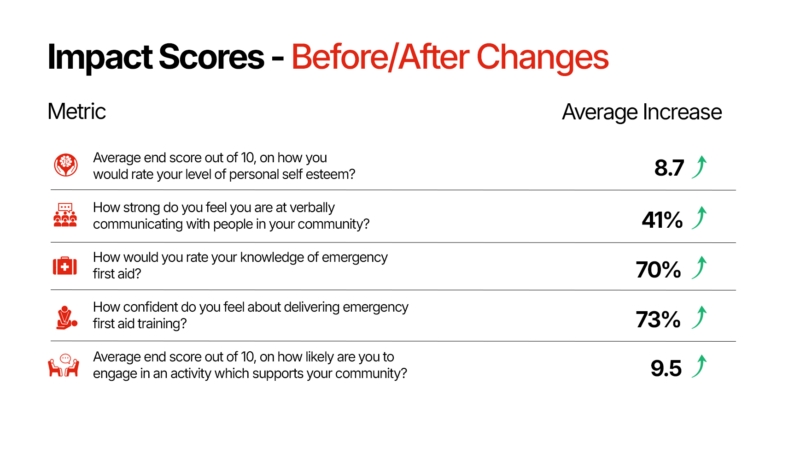
The evaluation findings show a strong and consistent positive impact across all core outcome areas, with participants demonstrating clear gains in confidence, practical skills and pro‑social attitudes. Notable increases were recorded in self‑esteem, communication skills and emergency first aid knowledge, alongside a particularly significant rise in confidence to support others, which reflects the effectiveness of the programme’s design. Participants reported greater willingness to support others and take part in activities that benefit their community, which were some of the highest scores and indicates increased motivation and a strengthening of personal responsibility. All participants who completed the programme said they would strongly recommend it with high satisfaction rates and perceived value.
The course has given me valuable insight into my past life and impacts on society and has given me an avenue to turn it around by helping people who are victims of violence instead of making victims of violence. I also now have the ability to potentially help others save a life or the life of someone I know!
Conclusion
The programme’s interactive, discussion led approach has driven high engagement and consistently positive outcomes, with evidence showing participants increased knowledge, skills and confidence, alongside greater willingness to support others and make positive choices. Participant feedback further highlights the value of longer term engagement, supporting deeper reflection, increased confidence and stronger development of peer‑led and social action activities. There is clear appetite for continued involvement, with participants volunteering to support future delivery and act as positive role models. Overall, the programme demonstrates strong potential to contribute to reduced reoffending by equipping individuals with the skills, confidence and motivation needed to progress towards safer, more positive futures.